Screening helps detect colorectal cancer early, when treatment is most effective.
Colorectal cancer can affect the colon (large intestine) or rectum and is the third most common cancer worldwide, accounting for approximately 10% of all cancer cases.
It predominantly affects individuals aged 50 and above, though there is a rising burden among younger adults. Several lifestyle factors contribute to the development of colorectal cancer such as a high intake of processed meats and low intake of fruits and vegetables, a sedentary lifestyle, obesity, smoking, and alcohol consumption. The incidence and impact of colorectal cancer can be significantly reduced by adopting a healthy lifestyle, avoiding risk factors, and facilitating early detection through screening.
More information is provided below.
What is colorectal cancer screening?
If you are between 50 and 74 years old you will automatically receive an invitation package to participate in the colorectal cancer screening program every 2 years.
The Center for Cancer Detection (CvKO) sends you an invitation letter and collection kit to take a sample of your stool yourself. The collection kit contains a test that detects blood in your stool that is invisible to the naked eye. Blood in your stool can indicate polyps or colon cancer.
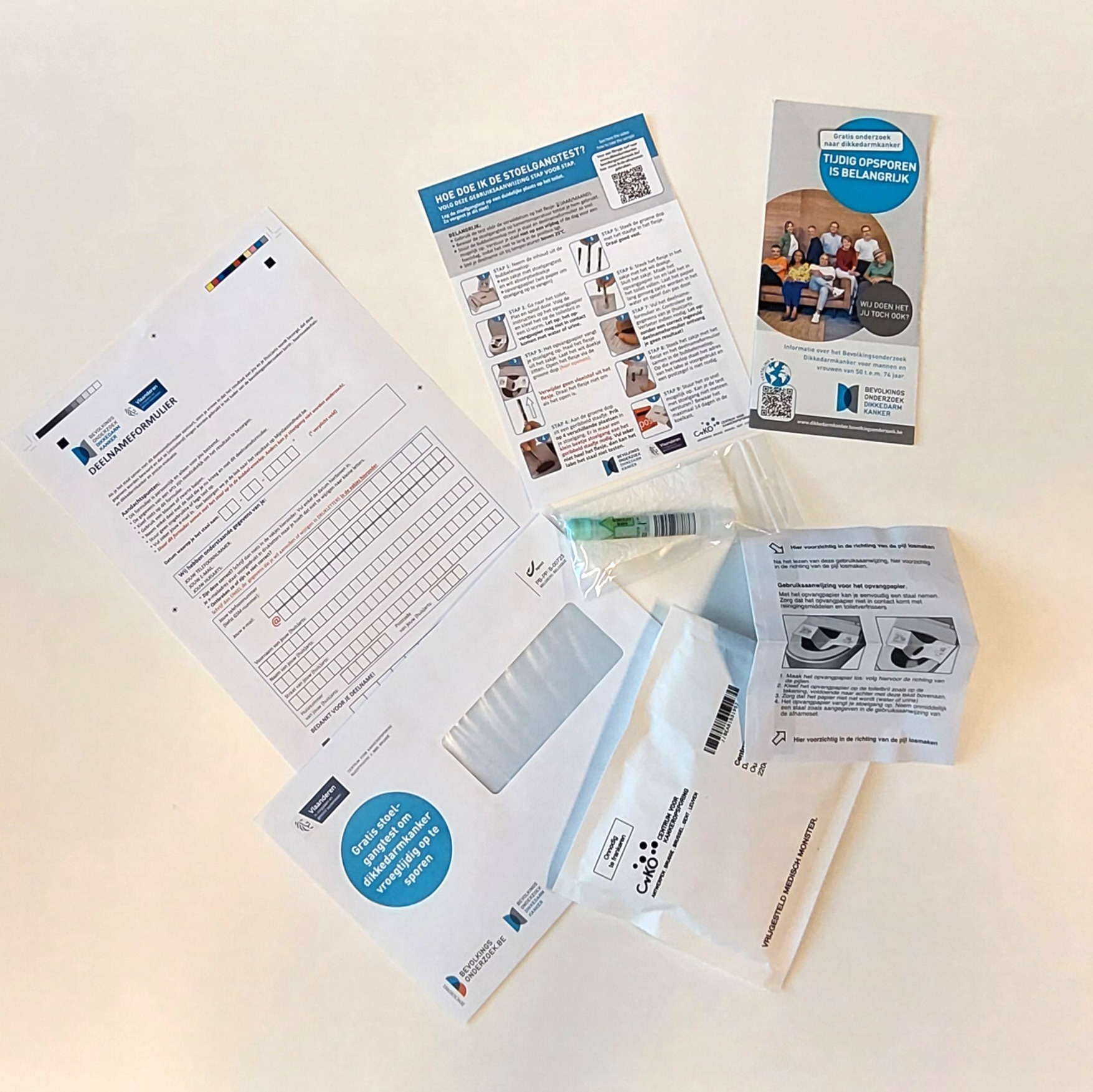
Source: Center for Cancer Detection (CvKO), 2026. |
To participate, you send a sample of your stool to the lab, along with the completed participation form (a postage stamp is not required). You will receive the result two weeks later.
Who is invited?
Every 2 years, the Centre for Cancer Detection (CvKO) sends people aged 50–74 years an invitation letter and a collection kit for the colorectal cancer screening programme.
Who will not be invited?
You will not be invited for the colorectal cancer screening programme if:
- you have been diagnosed with colon cancer in the past 10 years or are currently being treated for colon cancer;
- you have already taken a stool test in the past 2 years;
- you have had a colonoscopy in the past 10 years;
- you have had a virtual colonoscopy in the past 4 years;
- you are under 50 years old;
- you are over 74 years old.
Legal gender registration does not affect eligibility. You are eligible for the screening programme if you are aged 50–74 years and do not meet any of the exclusion criteria listed above.
Not sure why you have not received an invitation? Check when and whether you should be invited on the CvKO webiste.
If you are not invited but still want to have a stool test performed, you can always do this through your GP. In this case, the test is performed outside the colorectal cancer screening program organized by the Center for Cancer Detection and is therefore not free of charge. The laboratory analysis is covered under the standard Belgian health insurance system, so you will pay the applicable co-payment, as well as the usual patient contribution for the GP consultation (typically around €4).
I am younger than 50 / older than 69
Outside the age group 50-74, screening is not routinely offered:
- People younger than 50 years:
Although colorectal cancer can occur before the age of 50, the risk is lower than in older adults. In line with current European guidelines, the Flemish Colorectal Cancer Screening Programme starts at age 50. If you have symptoms, an increased personal or family risk, or wish to be screened earlier, consult your GP. - People older than 74 years:
The balance of benefits and harms of routine population screening after age 74 is less clear. If you wish to continue screening, discuss this with your GP.
Screening outside the organised programme is possible and follows the usual Belgian health insurance reimbursement rules.
I have a history of colorectal cancer
The information on this page applies to routine colorectal cancer screening in the general population. People with a previous diagnosis of colorectal cancer usually follow a personalized surveillance plan with their healthcare provider instead of participating in the organised screening program.
Your healthcare provider will advise you on the most appropriate follow-up and whether you should participate in the organised screening programme in the future.
What to do in case of symptoms or increased risk
The colorectal cancer screening program is designed for people without symptoms and at average risk of colorectal cancer.
If you develop symptoms, such as blood in your stool, a persistent change in bowel habits, ongoing abdominal pain, or unexplained weight loss, or if you have an increased risk of colorectal cancer (for example because of a family history, a hereditary condition, or inflammatory bowel disease), it is a good idea to discuss this with your GP or specialist. Your healthcare provider can advise whether you need further assessment or whether screening outside the organised program is more appropriate.
If you have symptoms or an increased risk, do not wait for your next screening invitation before seeking medical advice.
General Considerations
The information in this website is meant to provide general guidance and education. It cannot replace a medical consultation that takes into account a person’s medical history, risk factors, and preferences.
Screening is a very helpful prevention strategy, but it also has limitations and possible downsides that are important to discuss together with a healthcare provider.